A Buyer in Sahibabad Who Started With the Wrong Number
A man came to us last March with a budget written on the back of a visiting card. He’d called three dealers, got three quotes, and the lowest one was nearly half the highest. He wanted to know which dealer was lying. None of them were, as it turned out. They were each quoting a different machine, and he’d been comparing them like three kilos of rice.
He made cartons for a local appliance assembler, mostly 3-ply, some 5-ply when the customer got fussy. His shed was around 4,000 square feet. He had one operator he trusted and a nephew who did the billing. That was the whole setup.
I’m starting here because the corrugated box machine price people search for online is almost never the price they end up paying. The headline figure covers a bare machine, usually. Everything around it comes later, and it comes in installments.
What the Quotes Actually Covered
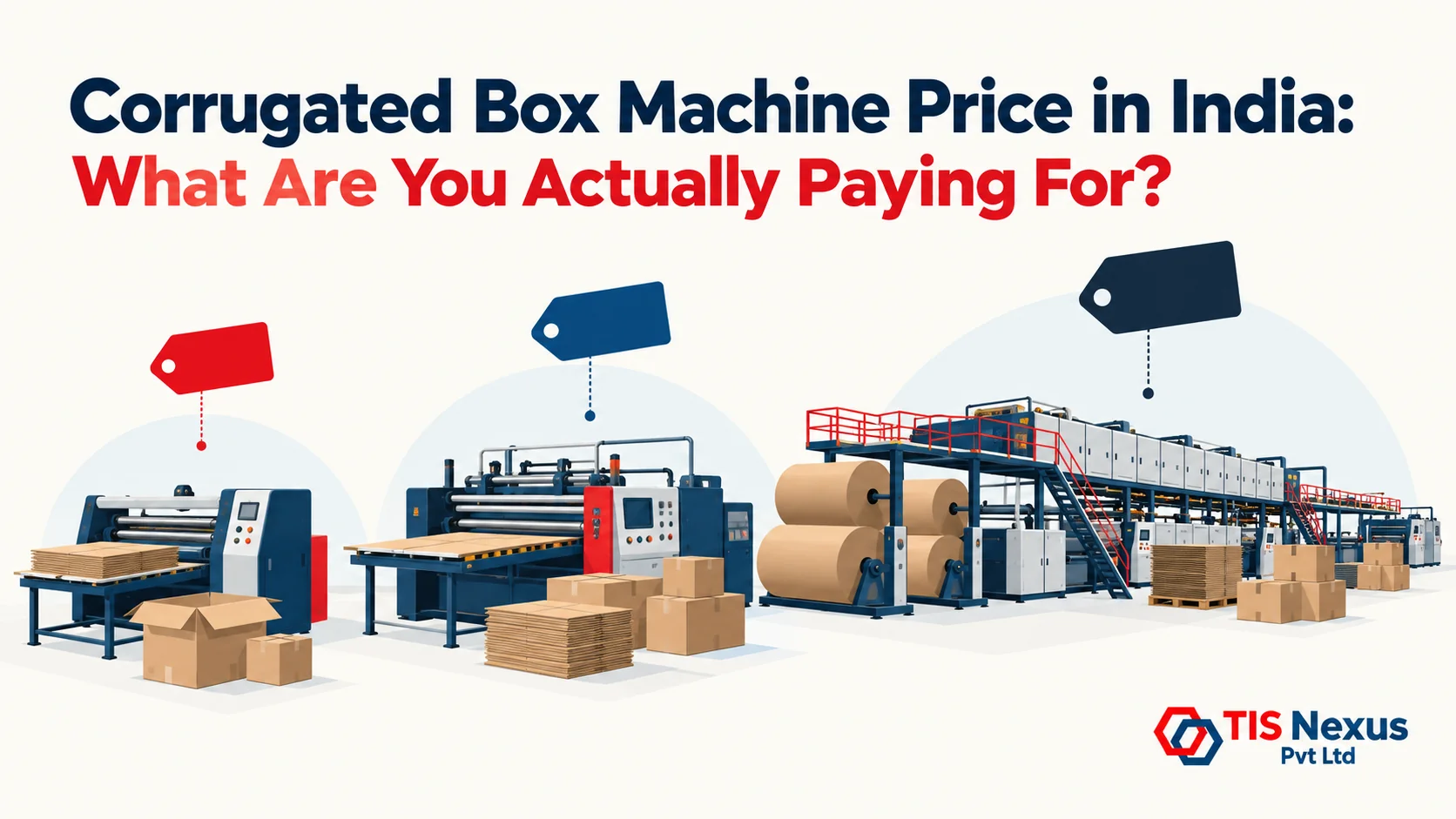
The cheap quote had a single-facer with a small paper width and a hand-fed stitcher. No boiler, no paper stand worth the name, no die-cutter. The dearest one was a full corrugation plant with a steam setup, a pre-heater, a proper stacker and a flexo printer slotter. Same word on the paper, “line”, and a gap of several lakhs between them.
Something like 8 to 10 lakh separates a semi-automatic starter setup from a decent automatic one, and that’s before you touch the corrugation side. For a full corrugation plant cost, with a 3-ply or 5-ply board line that makes its own sheets, buyers in this country are looking at crores. Not a small number. I’ve watched people go quiet in the office when the total gets read out.
Our man in Sahibabad didn’t need the crore-level plant. He needed to stop buying board from a trader who delayed every Diwali.
The Automatic Corrugated Machine Price Trap
I’ll say it plainly: most small converters overbuy on automation in the first year. The automatic corrugated machine price looks reasonable when a dealer breaks it into monthly figures, and the demo is lovely, everything humming and boxes dropping out clean.
Then you run it on your own orders. A converter I know in Ludhiana bought a fully automatic slotter in 2023, ran it on short runs of 300 to 500 boxes, and spent more time on changeover than on cutting. Setup eats the savings on short jobs. He told me later he’d have been better off with a semi-auto and a second operator, and he’s a man who doesn’t admit mistakes easily.
Long runs flip it. If you’re pushing 5,000 identical cartons for one customer, the automatic earns its keep in a month or two. Nobody can tell you your order mix from a brochure, and I include myself in that.
Where the Extra Money Goes
Power is a quiet one. Three-phase load for a corrugation setup is nothing like a stitcher and a cutter, and one buyer in Noida found out only after the electricity department sent a letter about his sanctioned load. He paid for the upgrade, waited weeks, and the machine sat under a tarp.
Then there’s the foundation. A corrugator wants a flat, properly cured floor, and I’ve seen a shed in Kanpur where the line was shimmed with steel plates for a year because nobody wanted to break the concrete again.
Walking Through One Job, Start to Finish
Here’s a case from last winter. A mid-size converter near Panipat, about 60 lakh to spend, wanted to start making his own board. He ran a printer-slotter already and bought sheets from outside.
His first idea was a 1,400 mm line. We asked what his widest carton was. It was around 1,050 mm of sheet width on the big appliance jobs, so he could have gone narrower and saved something like 12 to 15 lakh. He grumbled about it. Said he wanted room to grow.
Fair enough, but growth in his town meant the same three customers, and none of them were changing carton sizes. He went with 1,250 mm, which left some slack. The paper reel stand and the boiler took another big bite that he hadn’t planned for, and he ended up phasing the purchase, boiler and corrugator first, pre-heater and the rest the following season.
Six months in, he told me the phasing was the smartest accident of the whole project. Cash flow stayed alive. He’d have been strangled if everything landed at once.
Corrugation Plant Cost Versus What You Can Run
Talk to anyone who has been in this trade for twenty years and they’ll tell you the plant is the easy part. Paper is the hard part. A 3-ply line eats reels all day, and if your paper supplier is unreliable, the best corrugator in the country is an expensive ornament.
I’ve seen two plants in Uttar Pradesh sit idle for weeks because the owners hadn’t lined up a second kraft supplier. Both had bought good machines. Both had cash locked up in them and no board coming out.
Running costs deserve more attention than they get. Steam, power, starch, paper wastage on startup. A new line wastes a lot of paper in the first weeks while the operators learn the feel of it, and I’ve seen owners get properly shaken by the scrap pile. It settles. Mostly.
A Mistake I See Almost Every Month
Buyers compare the machine price and forget to ask what’s included in the delivery and installation. Freight on a corrugator is not small, and the crane for unloading is a separate hire. One buyer in Jaipur found out on the day the truck arrived that nobody had arranged a crane, and the driver wanted his money and wanted to leave. They stood in the yard for hours.
Second part of the same mistake is spares. Ask what the first year of wear parts costs, and who in your region can fix a gearbox at eleven at night. A cheap quote from a dealer three states away looks great until a corrugating roll bearing goes in peak season.
Where We Usually Send People to Look
When someone is still deciding between a starter setup and a full plant, we point them toward the range at TIS Nexus corrugated box making plants, because the specs are laid out by capacity and you can see where the price jumps happen. Seeing the jumps is half the education. The sheet width, the speed, the ply capacity, each one moves the figure in its own way.
I’d also say talk to a converter who’s already running a similar line before you sign anything. Walk his floor. Ask what he’d change. It costs a train ticket and a lunch, and I can’t think of a cheaper way to avoid a bad decision.
Reading the 2026 Market
Steel prices have been jumpy, and dealers have been slow to hold quotes for more than a couple of weeks. A buyer in Gujarat told me his quote moved between the first call and the token payment, and the dealer shrugged it off as raw material. Maybe. Maybe not.
Used machines are tempting right now. I like a good second-hand slotter, honestly, they’re simple and forgiving. A second-hand corrugator is a different animal. The rolls wear, the grooves flatten, and board quality drifts in ways you only see after you’ve already paid. I wouldn’t spend my own money there unless I’d run the line myself first.
For anyone sizing the plant for the first time, the packaging machinery range is a decent place to compare what a given budget buys at each tier. And the Sahibabad man? He bought the mid-range semi-automatic, kept his nephew on billing, and ordered a second paper supplier before the machine even arrived.